
Think lifting should be a mystery?
Too many plans sell hype and leave you guessing, sore, or stuck.
This post cuts the noise and gives a clear, usable system: two ready templates (3-day full-body and 4-day upper/lower), simple set and rep targets, and a step-by-step progression you can track.
Follow it for 8 to 12 weeks, add small weight or reps each week, and you’ll see real strength gains without burning out.
If you want less guessing and more steady results, read on.
Ready-to-Follow Sample Strength Program (3- and 4-Day Templates)

A structured strength training program starts with a clear weekly schedule that fits your life and builds measurable strength without guessing. The 3-day full-body template puts every major lift into each session three times per week, so you hit squat, press, and pull variations Monday, Wednesday, and Friday. Simple, proven, ideal if you’re balancing work, family, or just want fewer gym days. The 4-day upper/lower split divides your week into two upper days and two lower days, letting you add more volume and focus without turning every session into a marathon.
Both templates follow the same core principle: main barbell lifts performed at 3 to 6 reps for strength, followed by accessory work at 6 to 12 reps to build muscle and protect joints. A typical program runs 8 to 12 weeks, with beginners often seeing 5 to 15% increases in their estimated 1-rep max by the end. You don’t need to invent anything. Just show up, follow the sets and reps, add a little weight each week, and track what you did.
3-Day Full-Body Template (Mon/Wed/Fri):
- Barbell back squat: 4 sets × 4 to 6 reps, 2 to 4 minutes rest
- Flat bench press: 4 sets × 4 to 6 reps, 2 to 4 minutes rest
- Barbell row (or Pendlay row): 3 sets × 6 to 8 reps, 2 minutes rest
- Romanian deadlift: 3 sets × 6 to 8 reps, 2 minutes rest
- Bulgarian split squat or lunges: 3 sets × 8 to 10 reps per leg, 90 seconds rest
- Face pulls or band pull-aparts: 3 sets × 12 to 15 reps, 60 seconds rest
- Dumbbell lateral raises: 3 sets × 10 to 12 reps, 60 seconds rest
- Plank hold or dead bug: 3 rounds × 30 to 60 seconds, 60 seconds rest
4-Day Upper/Lower Template (Mon/Tue/Thu/Fri):
Upper A: Bench press 5×3 to 5, barbell row 4×6 to 8, overhead press 3×5 to 6, weighted pull-ups 3×6 to 8, triceps pushdowns 3×8 to 12.
Lower A: Back squat 5×3 to 5, Romanian deadlift 3×6 to 8, Bulgarian split squat 3×8 to 10 per leg, standing calf raises 3×12 to 15.
Upper B: Incline dumbbell bench 4×6 to 8, weighted chin-ups 4×4 to 6, seated dumbbell press 3×8 to 10, face pulls 3×12 to 15.
Lower B: Conventional deadlift 4×3 to 5, front squat or pause squat 3×5 to 6, lying leg curl 3×10 to 12, cable crunch 3×12 to 20.
These templates give you a ready framework that covers every muscle group, prioritizes the big lifts, and leaves room to progress. They’re not flashy, and that’s the point. Structure means you know exactly what to do, you track it, and you see real strength gains over 8 to 12 weeks without burning out or second-guessing your plan.
How a Structured Strength Plan Works Mechanically

Strength programs work because they manipulate three variables in a planned sequence: load (how much weight), volume (how many sets and reps), and intensity (how close to your maximum effort). A structured plan adjusts these across weeks so your body adapts without overtraining or stalling. Most plans use block-style linear progression. Weeks 1 through 3 build volume at moderate loads (70 to 80% of your 1-rep max), week 4 cuts back for a deload, weeks 5 through 7 increase intensity to 75 to 90% while reducing reps, and week 8 tests your new strength or tapers into recovery.
Progressive overload is the engine. Each week you either add 2.5 to 5% to the bar (roughly 2.5 to 10 pounds depending on the lift and your strength level) or you add 1 to 2 reps per set until you hit the top of the range, then increase weight and reset reps. For example, if you squatted 135 pounds for 4 sets of 5 reps in week 1, you aim for 140 pounds in week 2. If you can’t add weight yet, you do 4 sets of 6 reps at 135, then bump the load next session. This incremental approach keeps progress steady without big jumps that wreck your form or leave you so sore you can’t train the next week.
Rest intervals matter as much as the weight. Heavy main lifts need 2 to 5 minutes between sets so your nervous system and muscles can recover enough to move the load with good technique. Accessory work, those 6 to 12 rep sets for hypertrophy and joint health, only needs 60 to 120 seconds of rest because you’re not chasing maximal force output, just controlled muscle tension.
The Five Pillars of Mechanical Progression:
- Load increases: add small, consistent weight increments weekly (upper body 1.25 to 2.5 kg, lower body 2.5 to 5 kg).
- Volume adjustments: build total weekly sets in the first block, then reduce volume slightly while increasing intensity in the second block.
- Intensity zones: use 70 to 80% 1RM early for technique and volume, then shift to 75 to 90% for peak strength.
- Planned deloads: reduce sets by 30 to 50% or drop load by 10 to 20% every fourth week to let tissues recover.
- Rep-range targeting: 3 to 6 reps for strength, 6 to 12 reps for accessory hypertrophy, each serving a distinct training adaptation.
| Phase | Weeks | Focus |
|---|---|---|
| Build | 1 to 3 | Volume accumulation at 70 to 80% 1RM, 4 to 6 reps per set |
| Deload | 4 | Reduce volume 40 to 60% and/or load 10 to 20%, maintain technique |
| Intensify | 5 to 7 | Increase load to 75 to 90% 1RM, lower reps to 3 to 5, fewer total sets |
| Test/Taper | 8 | Re-test 1RM or perform heavy singles/doubles, then rest |
This mechanical structure turns “lifting weights” into a predictable system where effort translates to measurable gains, not random soreness.
Types of Structured Strength Training Program Splits

Choosing the right split means matching your weekly availability and recovery capacity to a schedule that hits every major movement pattern with enough frequency and rest.
Full-Body Split
A full-body split trains all major muscle groups in one session, repeated three times per week on non-consecutive days. Each workout includes a squat or hinge, a horizontal press, a horizontal or vertical pull, and accessory work for smaller muscles and core. Because you’re doing compound lifts three times weekly, you get high movement frequency without excessive volume per session. That’s why it works well for beginners who benefit from frequent practice and intermediates who want efficient progress without living in the gym.
- Hits every movement pattern three times per week for fast motor learning.
- Sessions last 45 to 75 minutes depending on rest periods and accessory choices.
- Requires only three gym days, leaving four rest or cardio days.
- Weekly heavy sets per lift: 9 to 12 across the three sessions.
Upper/Lower Split
An upper/lower split divides your week into two upper-body days and two lower-body days, typically Monday/Thursday upper and Tuesday/Friday lower (or any four-day pattern). This split lets you add more sets per muscle group in each session because you’re not trying to fit everything into 60 minutes. You can do two pressing variations and two pulling variations in one upper day, or pair squat and deadlift work across two lower days without total-body fatigue crushing your performance on the last exercises.
- Allows higher volume per muscle per session compared to full-body.
- Four training days per week with three full rest days.
- Upper days: bench, overhead press, rows, pull-ups, arms; lower days: squats, hinges, single-leg work, calves, core.
- Weekly heavy sets per major lift: 6 to 10 per movement, spread across two focused sessions.
Push/Pull/Legs Split
A push/pull/legs split organizes training by movement type: push (chest, shoulders, triceps), pull (back, biceps, rear delts), and legs (quads, hamstrings, glutes, calves). Most lifters run this as a six-day program (push/pull/legs twice per week) or a five-day rotation. It offers the highest training frequency for each muscle, hitting chest or quads twice every seven to nine days, and allows specialization, so you can load up on pressing volume one day without worrying about deadlifts the next morning.
- Six-day version: Monday push, Tuesday pull, Wednesday legs, Thursday push, Friday pull, Saturday legs, Sunday rest.
- Each session focuses on one movement category, so you can go hard without systemic fatigue.
- Main lifts get 4 to 5 sets, accessories 3 sets, for a total of 12 to 18 weekly sets per muscle.
- Best for intermediate and advanced lifters with time, recovery capacity, and clear hypertrophy or strength goals.
| Split Type | Weekly Frequency | Main Focus |
|---|---|---|
| Full-Body | 3 days | Movement practice and balanced strength for all lifts |
| Upper/Lower | 4 days | Higher volume per muscle without daily full-body fatigue |
| Push/Pull/Legs | 5 to 6 days | Maximum frequency and specialization per muscle group |
Weekly Structure and Sample Training Templates
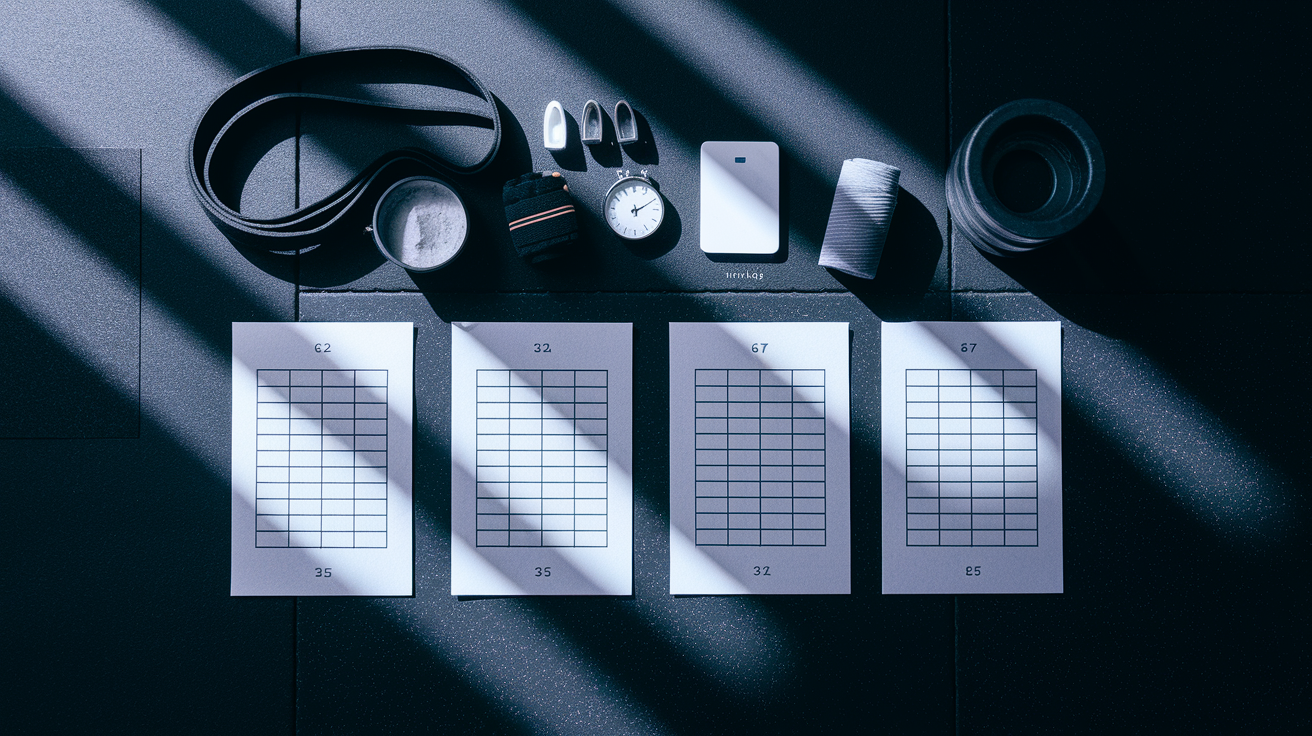
Weekly structure means knowing which lifts happen on which days, in what order, and with how much rest, so every session has a clear job and you’re not improvising mid-workout.
For a 3-day full-body program, each session opens with a lower-body compound (squat or deadlift variant), moves to an upper-body press (bench or overhead), then a pull (row or pull-up), and finishes with accessory work for weak points and injury prevention. Monday might be back squat 4×4 to 6 reps with 3 minutes rest, flat bench press 4×4 to 6 with 3 minutes rest, barbell row 3×6 to 8 with 2 minutes rest, Romanian deadlift 3×6 to 8 with 2 minutes rest, then face pulls 3×12 to 15 and planks 3×45 seconds. Wednesday and Friday follow the same structure but may swap exercises slightly. Front squat instead of back squat, incline press instead of flat, or dumbbell rows instead of barbell, to distribute stress and keep joints happy across the week.
A 4-day upper/lower template splits volume more cleanly. Upper day A prioritizes heavy bench press (5×3 to 5) and barbell rows (4×6 to 8), adds overhead press (3×5 to 6) and weighted pull-ups (3×6 to 8), then finishes with triceps pushdowns (3×8 to 12). Lower day A leads with back squat (5×3 to 5), Romanian deadlift (3×6 to 8), Bulgarian split squats (3×8 to 10 per leg), and calf raises (3×12 to 15). Upper day B uses incline dumbbell bench (4×6 to 8) and weighted chin-ups (4×4 to 6) as primary movements, with seated dumbbell press (3×8 to 10) and face pulls (3×12 to 15) as accessories. Lower day B opens with conventional deadlift (4×3 to 5), follows with front squat or pause squat (3×5 to 6), lying leg curls (3×10 to 12), and cable crunches (3×12 to 20). Rest intervals stay 2 to 4 minutes for main compound lifts and 45 to 90 seconds for isolation moves. For guidance on structuring these progressions across multiple weeks, the 8-week super strength workout offers detailed periodization examples.
Sample Session Elements Across Splits:
- Full-body Monday: Squat 4×5, bench 4×5, barbell row 3×8, RDL 3×8, accessory circuit.
- Full-body Wednesday: Front squat 4×5, overhead press 4×5, pull-ups 3×6 to 8, leg press 3×10, core.
- Full-body Friday: Deadlift 4×5, incline bench 4×5, dumbbell row 3×8, lunges 3×10 per leg, rear delts.
- Upper/lower upper A: Bench 5×3, row 4×8, OHP 3×6, chin-up 3×8, arms.
- Upper/lower lower A: Squat 5×3, RDL 3×8, split squat 3×10, calves.
- Upper/lower upper B: Incline DB bench 4×8, weighted pull-up 4×6, DB press 3×10, face pulls.
- Upper/lower lower B: Deadlift 4×3, front squat 3×6, leg curl 3×12, abs.
- PPL push day: Bench 5×5, overhead press 4×6, dips 3×8, lateral raises 3×12, triceps 3×10.
- PPL pull day: Deadlift 4×5, barbell row 4×6, pull-ups 3×8, face pulls 3×12, biceps 3×10.
Total weekly sets land between 12 and 20 per major muscle group, with main lifts getting 2 to 4 minutes rest and isolation moves 45 to 90 seconds, balancing strength adaptation with muscle growth and joint health.
Progression, Overload, and Periodization Models

Periodization is the planned manipulation of training variables (reps, sets, load, intensity) across weeks and months so you don’t stall, overtrain, or get bored. The simplest model is linear periodization: start with moderate weight and higher reps (say, 70% of your 1RM for 4 to 6 reps), add a little weight each week, and by week 8 you’re lifting 85 to 90% for 2 to 3 reps. Weeks 1 through 3 build volume and technical confidence, week 4 is a deload where you cut sets by 30 to 50% or drop load by 10 to 20% to let connective tissue catch up, weeks 5 through 7 push intensity higher with heavier weights and fewer reps, and week 8 either tests your new 1-rep max or tapers into rest before starting the next cycle.
Undulating periodization varies rep ranges and intensity within the same week instead of across weeks. Monday might be squat 5×3 at 85% for strength, Wednesday squat 4×8 at 70% for hypertrophy, and Friday squat 3×5 at 78% for a middle-ground stimulus. This approach works well for intermediate lifters who recover quickly and want to train multiple qualities at once without waiting weeks to shift focus. The downside is it requires more planning and can feel scattered if you’re still learning to push hard on heavy days.
Block periodization organizes training into distinct mesocycles, each emphasizing one goal. A hypertrophy block might run 4 weeks with 8 to 12 reps and moderate loads, followed by a 4-week strength block with 3 to 5 reps and heavy loads, then a short peaking block with singles and doubles before a competition or test. Each block builds on the last, and you cycle through them over months or years. That’s how serious lifters keep making progress after the beginner phase ends.
Core Periodization Principles:
- Linear: gradually increase load week to week, decrease reps, peak at high intensity in final weeks.
- Undulating: vary rep ranges and intensity within each week to train strength and hypertrophy simultaneously.
- Block: dedicate entire mesocycles to one training quality (volume, strength, power) before shifting focus.
- Deload frequency: insert a lighter week every 3 to 4 weeks to prevent accumulated fatigue from halting progress.
| Model | Rep Strategy | Intensity Strategy | Best For |
|---|---|---|---|
| Linear | Start high reps, drop weekly | Start 70%, end 85 to 90% | Beginners, simple long-term gains |
| Undulating | Rotate rep ranges within week | Heavy, moderate, light days each week | Intermediates with good recovery |
| Block | Fixed per mesocycle | One quality per block (volume → strength → peak) | Advanced lifters, specific competition prep |
| Autoregulated | Adjust daily by RPE/RIR | Vary based on session readiness | Experienced trainees managing fatigue |
For load increments, add 1.25 to 2.5 kilograms (roughly 2.5 to 5 pounds) per week on upper-body lifts and 2.5 to 5 kilograms (5 to 10 pounds) on lower-body lifts. If you can’t add weight, add one or two reps per set until you hit the top of the range, then increase load and reset reps to the bottom. Track everything. Date, exercise, sets, reps, weight, and RPE (rate of perceived exertion, where 6 is moderate and 9 is one rep from failure) so you know whether you’re actually progressing or just showing up and hoping.
Warm-Up, Mobility, and Pre-Lifting Preparation

Warming up isn’t optional filler. It primes your nervous system, lubricates joints, and rehearses movement patterns so your first working set doesn’t feel like a cold shock. Start with 5 to 10 minutes of light cardio: walk on an incline treadmill, ride a bike, or jump rope at an easy pace until you feel warm and your heart rate is slightly elevated. Follow that with dynamic stretches and mobility drills (leg swings, arm circles, hip openers, thoracic rotations) for another 5 minutes, targeting the joints and ranges you’ll use in the session.
Next come lift-specific ramp sets, which bridge the gap between your warm-up and your working weight. If your first working set of squats is 225 pounds for 4 reps, your ramp might look like this: empty barbell for 10 reps, 115 pounds (roughly 50% of 225) for 5 reps, 160 pounds (70%) for 3 reps, 190 pounds (85%) for 1 rep, then your first working set at 225. Each ramp set gets progressively heavier and uses fewer reps, so you’re not fatiguing yourself but you’re teaching your body the exact groove and load it’s about to handle. Rest 60 to 90 seconds between ramp sets and 2 to 3 minutes before your first working set.
Mobility work doesn’t need to be complicated. Spend 10 to 15 minutes twice a week on problem areas. Hip flexor stretches if you sit all day, thoracic extensions if your upper back is stiff, ankle dorsiflexion drills if your squat depth suffers. Include posterior chain and scapular stabilizer exercises like band pull-aparts, face pulls, or YTW raises to keep your shoulders healthy under heavy pressing volume. If you skip this, you’ll eventually pay for it with achy joints or a tweak that sidelines you for weeks.
Essential Warm-Up and Mobility Habits:
- Light cardio for 5 to 10 minutes to raise core temperature and heart rate.
- Dynamic stretches and joint mobility for 5 minutes, focused on hips, shoulders, ankles, thoracic spine.
- Lift-specific ramp sets: bar ×10, 50% working weight ×5, 70% ×3, 85% ×1, then working sets.
- Weekly mobility sessions of 10 to 15 minutes targeting individual limitation areas (hip flexors, ankle mobility, t-spine rotation).
- Scapular and posterior chain prehab: band pull-aparts, face pulls, or prone Ys twice per week, 2 to 3 sets of 12 to 15 reps.
Accessory Work and Exercise Selection Strategy

Accessory exercises are the supporting cast that protects your joints, builds muscle in weak areas, and keeps your program balanced so you don’t turn into a guy who can bench 300 but can’t do a single pull-up. They typically fall in the 6 to 12 rep range for 3 to 4 sets, using moderate loads at RPE 6 to 8, which means you could do a few more reps but you stop before failure. Accessories should complement your main lifts. If you’re squatting and deadlifting heavy, add Romanian deadlifts, lunges, or leg curls to target hamstrings and glutes from different angles; if you’re pressing a lot, include face pulls, rear delt flyes, and rows to balance shoulder health.
Exercise substitution is simple: if a movement hurts or you don’t have the right equipment, swap it for something that trains the same muscle and movement pattern. No barbell for bench press? Use dumbbells or push-ups with a weighted vest. Can’t do pull-ups yet? Do lat pulldowns or assisted pull-ups. Shoulder bothering you on overhead press? Try landmine presses or neutral-grip dumbbell presses. The goal is to keep training the muscle group safely, not to force a specific lift that wrecks you.
Substitution and Tempo Strategies:
- Match movement pattern and muscle group: horizontal press substitutes for horizontal press, vertical pull for vertical pull.
- Use dumbbells, bands, or machines when barbell work aggravates an injury or you lack equipment.
- Incorporate unilateral exercises (single-leg squats, single-arm rows) to identify and fix left-right imbalances.
- Apply tempo control (3-second eccentric, 1-second pause, explosive concentric) to increase time under tension without adding weight.
- Rotate accessory lifts every 4 to 6 weeks to prevent accommodation and keep joints adapting to slightly different stress angles.
Nutrition and Recovery for Strength Progress

You can’t out-train bad sleep and terrible eating. Strength programs work because they stress your muscles and nervous system, then recovery rebuilds them stronger. But that only happens if you give your body the raw materials and rest it needs. Aim for 7 to 9 hours of sleep per night, and treat it like a training variable you track and protect. One or two nights of 5 hours won’t ruin you, but chronic short sleep kills testosterone, raises cortisol, and makes every set feel twice as hard.
Protein is the most important nutrition lever for strength and muscle. Shoot for around 1.6 to 2.2 grams per kilogram of body weight daily, spread across 3 to 5 meals. That’s roughly 110 to 150 grams for a 150-pound person. Chicken, fish, eggs, Greek yogurt, lean beef, and protein powder all work. Complex carbs (rice, potatoes, oats, quinoa) fuel your training sessions and refill muscle glycogen, especially important on lower-body days and higher-volume weeks. Healthy fats from olive oil, nuts, avocados, and fatty fish support hormone production and joint health. Stay hydrated. Half your body weight in ounces of water daily is a decent baseline, more if you’re sweating a lot.
Post-workout nutrition doesn’t have to be fancy. Eating a meal with 20 to 40 grams of protein and some carbs within a couple of hours after training supports recovery. It’s not a magic anabolic window, but it helps if your next meal is 4 to 6 hours away. Supplements are optional but a few are useful: creatine monohydrate (5 grams daily) is the most researched and effective for strength and power; caffeine (100 to 200 mg pre-workout) can boost focus and performance on heavy days; whey protein is convenient when whole food isn’t practical.
Nutrition and Recovery Priorities:
- Sleep: 7 to 9 hours per night; track it like you track sets and reps.
- Protein: 1.6 to 2.2 g/kg body weight daily, spread across meals; prioritize whole sources (meat, fish, eggs, dairy).
- Carbohydrates: fuel training with complex carbs (rice, potatoes, oats); higher intake on heavy squat and deadlift days.
- Hydration: roughly half your body weight in ounces daily; more if training volume or temperature is high.
- Rest days: 1 to 2 full rest days per week for 4 to 6 day programs; light activity (walking, yoga, stretching) is fine.
- Supplements: creatine 5 g/day, caffeine 100 to 200 mg pre-workout, whey protein for convenience; none are mandatory if whole food intake is solid.
Tracking, Testing, and Long-Term Program Monitoring

Tracking turns “I think I’m getting stronger” into “I added 15 pounds to my squat in 8 weeks.” Write down the date, exercise name, sets, reps, weight, and RPE or reps in reserve (RIR, how many more reps you could have done) for every working set. A simple notebook works, or use a spreadsheet, app, or printable log. The act of recording forces you to be honest about whether you’re actually adding weight or reps, or just repeating the same session for months.
Test your baseline strength at the start of a program. Either estimate your 1-rep max using a 3 to 5 rep set and a calculator, or work up to a true 1RM if you have experience and a spotter. Record those numbers for squat, deadlift, bench press, and overhead press. At the end of week 8 (or week 9 after a deload), retest using the same method. Beginners often see 5 to 15% increases in estimated 1RM over 8 weeks; intermediates see smaller but still meaningful gains if programming and recovery are dialed in.
Weekly and monthly reviews keep you from drifting. Every week, check whether you hit your target reps and loads. If you missed reps two weeks in a row, you’re either adding weight too fast, not sleeping enough, or under-eating. If you’re crushing every set with reps to spare, you’re being too conservative. Add more load next week. Every month, compare total weekly sets per muscle group and make sure you’re in the 12 to 20 set range for each major movement. Adjust volume up if progress stalls, or down if fatigue and soreness are piling up faster than strength.
Tracking and Testing Tools:
- Training log fields: date, exercise, sets, reps, weight, RPE or RIR, technique and fatigue notes.
- 1RM or 3 to 5RM tests: perform at the start of a program and retest after 8 to 9 weeks to measure progress.
- Progression charts: simple spreadsheet with weeks across the top, lifts down the side, filled cells showing load and reps completed.
- Weekly set totals: count how many hard sets per muscle group you did that week; target 12 to 20 for strength and hypertrophy balance.
Adapting Your Strength Program for Different Goals

A structured program is a template, not a one-size-fits-all prescription. If your main goal is maximum strength, shift the rep ranges lower (1 to 5 reps for all main lifts) and add more barbell frequency. Drop some accessory volume and focus on the big four: squat, deadlift, bench, overhead press. Rest longer (3 to 5 minutes), keep intensity high (80 to 95% of 1RM), and track every single rep because progress is measured in pounds on the bar, not pump or soreness.
For hypertrophy and muscle growth, increase total weekly sets to 10 to 20 per muscle group, use rep ranges of 6 to 12 on most exercises, and add more variety (dumbbell work, cables, machines, different angles). Shorten rest periods to 60 to 90 seconds to create more metabolic stress. Keep the main lifts as anchors but treat accessory work as equally important. If you’re eating in a caloric surplus and sleeping well, muscle size will follow volume and progressive tension.
If you’re chasing fat loss while maintaining strength, keep the main lifts heavy (3 to 6 reps) to preserve muscle and strength, but add conditioning work on off days. 20 to 30 minutes of low-intensity cardio or circuits with light dumbbells and bodyweight moves. Increase your daily non-exercise activity thermogenesis (NEAT): walk more, take stairs, stay moving throughout the day. Don’t slash calories so hard that your performance crashes; a moderate deficit of 300 to 500 calories per day lets you lose fat without tanking your lifts.
Athletic performance and power adaptations include Olympic lift variations (cleans, snatches), plyometrics (box jumps, broad jumps, med ball throws), and speed work with the barbell at 30 to 60% of your 1RM for explosive sets of 1 to 5 reps. Contrast training, pairing a heavy compound lift with an explosive movement, like back squat followed by box jumps, trains your nervous system to recruit muscle fibers fast, which translates to better sprinting, jumping, and throwing.
Goal-Specific Program Adjustments:
- Strength focus: 1 to 5 reps, 3 to 6 sets per main lift, 80 to 95% intensity, longer rest (3 to 5 minutes), fewer isolation exercises.
- Hypertrophy focus: 6 to 12 reps, 3 to 5 sets per exercise, 10 to 20 weekly sets per muscle, 60 to 90 second rest, more exercise variety and angles.
- Fat loss with strength preservation: keep main lifts heavy (3 to 6 reps), add 2 to 3 weekly conditioning sessions, increase daily NEAT, moderate caloric deficit (300 to 500 kcal).
- Athletic/power development: include Olympic lifts or jump variations (1 to 5 reps, explosive intent), speed sets at 30 to 60% 1RM, contrast training (heavy lift + plyometric).
- Injury or limitation management: swap aggravating exercises for pain-free alternatives, use unilateral work and tempo control to rebuild weak areas.
- Aging athletes (50+): prioritize joint-friendly variations (dumbbells over barbells when needed), slightly higher rep ranges (5 to 8 instead of 3 to 5), more mobility and recovery work, conservative load progression.
How to Apply a Structured Strength Training Program in Real Life
Real life means work deadlines, family dinners, travel, and days when you’re tired or stressed. A program only works if it fits the life you actually have, not the life you wish you had. If you can realistically train four days a week for 60 minutes, pick the 4-day upper/lower split and guard those four sessions like appointments you can’t miss. If you only have three days and 45 minutes per session, run the
Final Words
Hit the gym with the 3-day and 4-day templates, follow the sets/reps for main lifts and accessories, and run the 8-week block with a deload week. Use the warm-up, mobility drills, and accessory swaps to stay consistent and avoid injury.
Log weights, RPE, and retest after eight weeks, and tune your protein, sleep, and easy recovery days so you actually get stronger.
This structured strength training program gives a clear, repeatable path—do the work, track it, and expect steady gains.
FAQ
Q: What is the 3-3-3 rule for gym?
A: The 3-3-3 rule for gym is a simple strength template using three sets of three reps for main lifts, often spread across three weekly sessions to build strength while keeping weekly volume low.
Q: What is structured strength training?
A: Structured strength training is a planned program that sets exercises, sets, reps, progression, and recovery so you steadily increase strength through progressive overload and scheduled deloads.
Q: Can I lift weights with fibromyalgia?
A: You can often lift weights with fibromyalgia, but start very gently, pace by symptoms, favor lighter loads and higher reps, and clear your plan with a doctor or physiotherapist.

