
Think you need an hour at the gym to build strength? Think again.
In 30 focused minutes you can hit squats, hinges, pushes, pulls, lunges, and core, no filler and no commute.
This post gives a complete, timed 30-minute routine professionals can do at home, in an office, or at the gym.
You’ll get a 3-minute warm-up, two 12-minute main blocks, a 3-minute finisher, plus simple scaling and scheduling tips to make it stick.
Do this three times a week and you’ll build real strength, fix posture, and feel more energized.
Complete 30-Minute Strength Workout for Busy Professionals

A structured 30-minute strength workout gives you everything you need without the filler. Stack compound movements that hit multiple muscle groups at once, and you’ll get more done per minute than most people do in an hour. This routine breaks down into three timed blocks: quick warm-up, main strength circuit, and a finisher. Your heart rate stays up, you build real strength, and you’re done before your coffee gets cold.
Complete 30-Minute Routine:
- Warm-Up Block (3 minutes): Arm circles × 30 seconds, bodyweight squats × 10, hip hinges × 10, band pull-aparts × 10, quick march in place × 60 seconds
- Main Strength Block A (12 minutes, 3 rounds): Goblet squat × 10 reps, push-ups × 10 reps, bent-over dumbbell row × 10 each arm, rest 30 seconds between exercises
- Main Strength Block B (12 minutes, 3 rounds): Romanian deadlift × 10 reps, overhead press × 8 reps, reverse lunge × 8 each leg, rest 30 seconds between exercises
- Finisher (3 minutes): Plank hold × 45 seconds, rest 15 seconds, repeat × 3 rounds
You’re covering all the major movement patterns here. Squat, hinge, push, pull, lunge, core. Legs, chest, back, shoulders, abs. All in less time than most meetings take. Run this three times per week with solid effort and you’ll build functional strength, fix your posture, and feel more energized. The trick is keeping rest short and picking exercises that recruit the most muscle in one go.
Why Short, High-Intensity Strength Workouts Are Effective

Short sessions work when you crank up the intensity. Pick compound lifts like squats, deadlifts, presses, and rows, and each one activates multiple joints and big muscle groups at the same time. That kind of recruitment drives muscle growth, neural adaptation, and metabolic demand way faster than curls and leg extensions ever could.
Research backs this up. Focused 20 to 30 minute sessions improve muscular strength and endurance when you keep the load challenging and control your rest. Your body doesn’t care about the clock. It responds to tension, volume, and how well you recover. Supersets, circuits, controlled tempo… all of these let you pack the stimulus you need into a tight window.
Busy professionals worry that shorter sessions won’t match hour-long gym marathons. But time under tension, effort level, and progressive overload matter more than how long you’re there. A 30-minute workout with six heavy compound movements and minimal rest can deliver equal or better strength gains than a longer session where you’re scrolling between sets. You just have to plan it right and cut out the filler.
Warm-Up Routine for Maximum Efficiency

A smart warm-up takes 3 to 5 minutes and gets your joints, nervous system, and muscles ready without eating into your main work. Dynamic movements boost blood flow, open up range of motion, and cut down injury risk, especially when you’re about to lift heavy or move fast.
Fast 5-Movement Warm-Up:
- Arm circles (forward and backward) × 30 seconds each direction
- Hip hinges (bodyweight good mornings) × 10 reps
- Bodyweight squats × 10 reps
- Band pull-aparts or scapular wall slides × 10 reps
- High knees or quick march in place × 60 seconds
These wake up your hips, shoulders, and spine in the exact patterns you’re about to load. You’re not stretching cold muscles. You’re rehearsing the squat, hinge, and press motions with light effort. By the time you pick up a dumbbell or barbell, your body’s ready to handle load safely. If you’re doing power or explosive work, toss in 5 to 10 light jumps or skips to wake up your nervous system.
Home vs. Gym Variations of the 30-Minute Workout
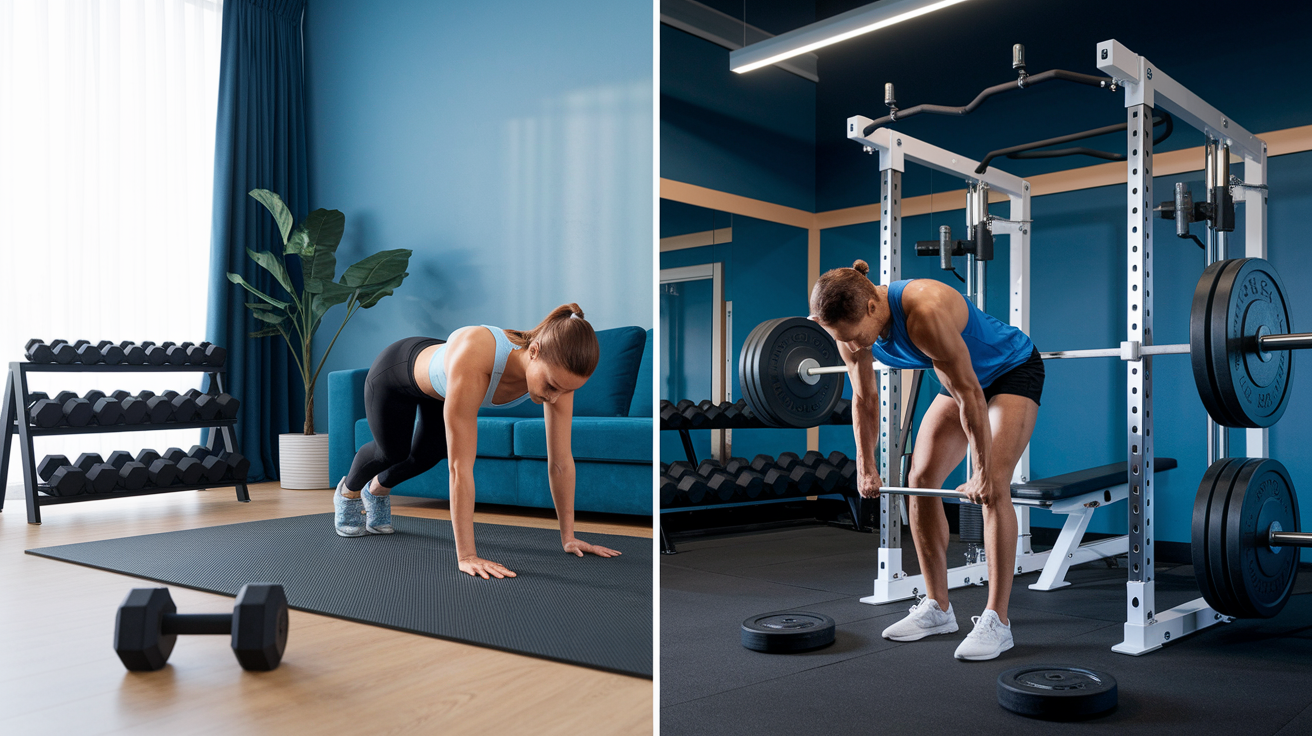
You can run this workout with minimal equipment at home or use gym tools for heavier loads and more variety. The structure stays the same. Only the exercise choices shift based on what’s available.
Home Setup (Bodyweight + Dumbbells or Bands):
- Squat: Goblet squat with one dumbbell or banded box squat
- Hinge: Single-leg Romanian deadlift with dumbbell or kettlebell
- Horizontal push: Push-ups (elevate hands for easier, elevate feet for harder)
- Horizontal pull: Bent-over dumbbell row or band row
- Vertical push: Dumbbell overhead press or pike push-up
- Lunge: Reverse lunge with dumbbells or walking lunge bodyweight
- Core: Plank hold or dead bug
- Vertical pull: Band-assisted pull-up or single-arm lat pull with band
Gym Setup (Barbell, Machines, Cables):
- Squat: Barbell back squat or front squat
- Hinge: Barbell deadlift or trap bar deadlift
- Horizontal push: Barbell bench press or dumbbell bench press
- Horizontal pull: Barbell bent-over row or cable row
- Vertical push: Barbell overhead press or dumbbell shoulder press
- Lunge: Barbell walking lunge or Bulgarian split squat with dumbbells
- Core: Cable Pallof press or hanging knee raise
- Vertical pull: Pull-ups or lat pulldown machine
Home workouts win for convenience and zero commute time. You save 20 to 30 minutes of travel and can lift in your garage or living room. Gym versions let you load heavier, use progressive barbell increments, and access machines for cable rows or lat pulldowns. Both deliver results if you keep intensity high and add load over time.
Scaling the Workout for Different Fitness Levels

The same 30-minute structure works for beginners, intermediates, and advanced lifters. You just adjust load, reps, rest, and complexity to match where you’re at right now.
Beginner Adjustments:
- Reduce rounds to 2 instead of 3
- Use bodyweight or very light dumbbells (5 to 15 lbs)
- Keep rest at 45 to 60 seconds between exercises
- Choose simpler movement patterns (goblet squat instead of barbell back squat)
- Slow tempo to 2-0-2 (2 seconds down, no pause, 2 seconds up)
- Target RPE 5 to 7 (moderate effort, not maximal)
Intermediate Adjustments:
- Complete 3 rounds as written
- Use moderate dumbbells or barbell (working weight you can control for 8 to 12 reps)
- Rest 30 to 45 seconds between exercises
- Mix bilateral and unilateral movements (single-leg Romanian deadlift, for example)
- Add tempo variation on one exercise per block (3-1-1: slow lower, pause, fast up)
- Target RPE 7 to 8 (challenging but sustainable)
Advanced Adjustments:
- Add a 4th round or increase sets to 4 on key lifts
- Use heavier loads for 6 to 8 reps instead of 10
- Shorten rest to 15 to 30 seconds or eliminate rest by supersetting opposing movements
- Incorporate explosive or tempo-contrast variations (pause squats or jump squats, for example)
- Add single-leg and unilateral overload (Bulgarian split squat with heavy dumbbells)
- Target RPE 8 to 9 (near-maximal effort with 1 to 2 reps left in reserve)
Beginners should focus on learning movement quality and building a habit. Intermediates can push volume and intensity within the 30-minute window. Advanced lifters squeeze more out of every minute by shortening rest, increasing load, or adding complexity like pause reps or cluster sets. All three levels follow the same plan. Only the dials change.
Scheduling and Consistency Strategies for Busy Professionals

Fitting three 30-minute sessions into a packed week takes intentional scheduling and removing decision friction. Treat your workout like a standing meeting. Non-negotiable, time-blocked in your calendar.
Morning sessions before work usually win for consistency. Energy’s highest, distractions are fewest, and you finish before emails start. If mornings don’t work, lunch breaks are the second-best window. A quick 30-minute lift mid-day resets your focus and breaks up long stretches of sitting. Evening sessions can work if you commit to a fixed time, but fatigue and last-minute work demands make them harder to protect.
Actionable Scheduling Strategies:
- Time-block workouts in your calendar as recurring appointments (Monday/Wednesday/Friday 6:00 to 6:30 AM, for example)
- Lay out workout clothes, shoes, and water bottle the night before
- Pre-program your workout in a notebook or phone app so you walk in knowing exactly what to do
- Stack your workout habit onto an existing routine (right after morning coffee or before your first meeting)
- Use a simple weekly goal: complete 3 sessions, yes or no. Track it on a visible scorecard
- Protect your session time by declining low-priority meetings during that window
- If you miss a planned session, reschedule it within 24 hours instead of waiting for next week
Consistency beats perfection. Three 30-minute sessions every week for 12 weeks will get you way better results than sporadic hour-long workouts when motivation’s high. Build the habit first, then tinker with the details.
When to Adjust Your Routine or Seek Guidance

Even a well-designed 30-minute plan will need updates after 6 to 12 weeks. Your body adapts, progress slows, or life changes. Knowing when to adjust keeps you moving forward instead of wasting weeks on a stale program.
If you’ve been lifting the same weights for the same reps for four weeks straight, you’ve hit a plateau. Add 2.5 to 5 pounds to your lifts, increase reps by 1 to 2 per set, or shorten rest by 10 to 15 seconds. If joint pain shows up during or after sessions (especially sharp pain in knees, shoulders, or lower back) check your form or swap the exercise for a pain-free variation. Persistent discomfort means you should talk to a coach or physical therapist before pushing through.
Indicators You Need a Routine Change or Expert Help:
- Same weights and reps for 4+ weeks with no increase in difficulty
- Sharp or persistent joint pain during specific movements
- Chronic fatigue or declining performance despite rest and nutrition
- Uncertain about form on key lifts (squat, deadlift, overhead press)
- Major life change (new job, travel schedule, injury recovery) that disrupts your current plan
A qualified strength coach can assess movement quality in one session and give you cues that prevent injury and unlock stuck progress. If you’re unsure whether your squat depth is safe or your deadlift setup is sound, 30 minutes with a professional saves months of spinning your wheels or risking an avoidable strain.
Final Words
You’ve got a full 30-minute plan, a quick warm-up, home and gym options, and scaling ideas. Use supersets or AMRAPs (as many reps as possible) to save time and keep intensity.
Pick the version that fits your gear and experience. Track one simple metric, weight lifted or reps, and nudge it weekly. If form feels off, dial back or get help.
Stick with these time-efficient 30-minute strength workouts for busy professionals three times a week and you’ll build strength, energy, and the habit. Small, steady steps win.
FAQ
Q: What is a complete 30-minute strength workout for busy professionals?
A: A complete 30-minute strength workout for busy professionals is a 3–5 minute dynamic warm-up, a 20-minute main block of compound lifts (supersets or AMRAP), and a 2–3 minute finisher covering lower, upper, and core.
Q: Why are short high-intensity strength workouts effective?
A: Short high-intensity strength workouts are effective because compound moves hit many muscles fast, intensity boosts strength and metabolic demand, and focused effort compensates for shorter session time.
Q: What should I do for a fast 3–5 minute warm-up?
A: A fast 3–5 minute warm-up should include arm circles, hip hinges, walking lunges, inchworms or dynamic toe touches, bodyweight squats, and light jumping jacks to raise heart rate and mobility.
Q: Can I do this workout at home with limited equipment?
A: You can do the workout at home with dumbbells, resistance bands, or bodyweight; gym versions let you use barbells and machines for heavier loads and simpler progressions.
Q: How do I scale the 30-minute workout for beginners, intermediates, and advanced?
A: You scale the 30-minute workout by lowering load and increasing rest for beginners, keeping moderate load and steady progression for intermediates, and adding weight, tempo changes, or supersets for advanced.
Q: How often should busy professionals do this 30-minute workout each week?
A: Busy professionals should do this 30-minute strength workout three times per week for full-body strength, or 2–4 times depending on recovery and training split preferences.
Q: What common mistakes should I avoid with a 30-minute strength workout?
A: Common mistakes to avoid are skipping the warm-up, sacrificing form for speed, doing too little progression, and not tracking load or recovery.
Q: How can I schedule this workout to stay consistent with a busy calendar?
A: You can schedule workouts by time-blocking 30 minutes, doing them the same days each week, stacking with daily habits, using lunch or early mornings, and packing gear ahead.
Q: When should I adjust my routine or consult a trainer?
A: You should adjust or consult a trainer when progress stalls, you experience pain or form breakdown, you hit plateaus, or you plan rapid load increases.
Q: What results can I expect from a consistent 30-minute strength routine?
A: A consistent 30-minute strength routine usually increases strength, preserves or builds muscle, boosts daily energy, and improves fitness within 4–8 weeks with steady progression.

