
Think three workouts a week can’t build real strength?
Most beginners walk into the gym fired up but follow random plans that stall progress.
This post shows a simple, repeatable 3-day full-body program that fixes that, a roadmap you can follow for weeks and see steady gains.
You’ll get exactly what to do each session, how to set reps and rests, and the easiest ways to add weight so you don’t guess or burn out.
No fluff, just small, smart steps you can start this week.
The Core Problem: Building a Beginner-Friendly 3‑Day Full‑Body Strength Program That Actually Works
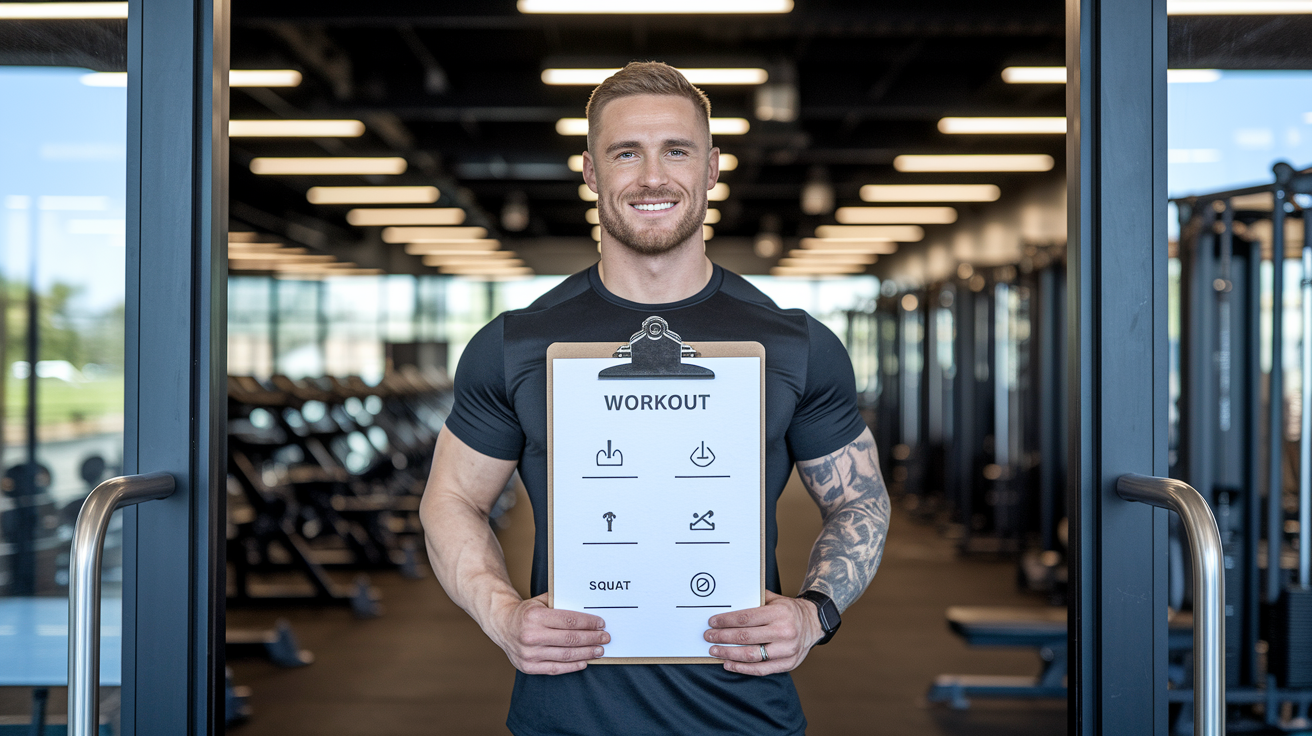
Most beginners walk into the gym fired up and ready to go. But the plan? Usually something they grabbed from Instagram or copied from a friend who’s been lifting for years. A few weeks later, progress stalls. Motivation tanks. And they’re left wondering if they’re doing too much, too little, or just completely wrong stuff.
The real problem isn’t effort. It’s structure. Without a clear roadmap, you’ll waste sessions guessing which exercises to do, how many sets feel right, and whether you should train shoulders today or save them for next week. A beginner-friendly 3‑day full‑body strength program fixes this by giving you a repeatable framework: train Monday, Wednesday, and Friday (or similar non‑consecutive days), prioritize compound lifts that hit multiple muscle groups at once, follow structured set and rep guidelines, and add small amounts of weight or reps each week. That’s it.
Here’s what you need to get started:
- Schedule 3 sessions per week with at least one rest day between (like Mon/Wed/Fri or Tue/Thu/Sat)
- Pick 4 to 6 exercises per session, starting with compound movements like squats, rows, and presses
- Begin with 2 sets per exercise and work up to 3 or 4 sets as your technique improves
- Use 8 to 12 reps for most lifts, resting 2 to 3 minutes between heavy compounds and 60 to 90 seconds for accessories
- Add weight or reps each week when you hit the top of your rep range with good form
This approach keeps every major muscle group (quads, hamstrings, glutes, chest, back, shoulders, and core) engaged three times per week. You’re maximizing practice frequency while leaving enough recovery time for muscle protein synthesis to do its job, which stays elevated for about 24 to 48 hours after a session.
Why Beginners Struggle to Build an Effective 3‑Day Full‑Body Program

The mistakes usually happen before the first set. Beginners often choose exercises because they look cool or showed up in a YouTube ad, not because those movements meet basic criteria like being pain‑free, allowing good form, and offering a clear way to progress. When your exercise list is built on hype instead of fundamentals, you end up spinning your wheels.
Ordering is another common stumbling block. Doing biceps curls before squats might feel fine in the moment, but you’ll be gassed when it’s time for the movements that actually drive strength and muscle. Add in guesswork around volume (like jumping straight to 5 sets per exercise because “more is better”) and under‑resting between heavy sets, and you’ve got a recipe for frustration and form breakdown.
Typical issues include:
- Selecting exercises that cause joint pain or can’t be loaded progressively
- Placing isolation movements before compound lifts, leaving you too tired for the hard stuff
- Starting with too many sets (4 to 5 per exercise) when 2 to 3 would build better technique and allow consistent recovery
- Resting only 30 to 60 seconds between heavy squats or deadlifts, forcing you to cut reps short or sacrifice form
Core Design Principles for a 3‑Day Beginner Full‑Body Strength Program

Good program design starts with exercise selection. Each movement you include should pass a simple four‑part test: it doesn’t cause pain, you can perform it with solid form, you feel the target muscle working, and you can make it harder over time by adding reps, weight, or sets. If an exercise fails any of those checks, swap it out.
Once you have a pool of qualified movements, order them by difficulty and priority. The most technical, physically demanding lifts (typically lower‑body compounds like squats and deadlifts) go first when you’re fresh. After those, slot in upper‑body compounds (rows, presses), then finish with isolation work. Pairing opposing muscle groups (an agonist/antagonist strategy, like doing a row followed by a press) helps manage fatigue and keeps performance steady across the session.
Selection rules:
- Choose pain‑free exercises you can perform with consistent technique
- Ensure you feel the intended muscle working during each rep
- Prioritize compound, multi‑joint movements over single‑joint isolation early in the session
- Use machine or supported variations (like chest‑supported rows) if balance or coordination limits your form
- Confirm the exercise allows progressive overload (adding load, reps, or range of motion over weeks)
- Start with 2 sets per movement and only increase to 3 or 4 after your technique is solid and recovery is consistent
| Exercise Type | Beginner Options |
|---|---|
| Lower-body compound | Goblet squat, leg press, barbell back squat, Bulgarian split squat |
| Hip hinge | Dumbbell Romanian deadlift, trap bar deadlift, machine lying leg curl |
| Horizontal push | Flat dumbbell press, barbell bench press, machine chest press, push-ups |
| Horizontal pull | Bent-over barbell row, chest-supported dumbbell row, seated cable row |
| Vertical push/pull | Machine shoulder press, dumbbell overhead press, lat pulldown, assisted pull-up |
Structuring Weekly Training: How to Schedule a 3‑Day Full‑Body Routine
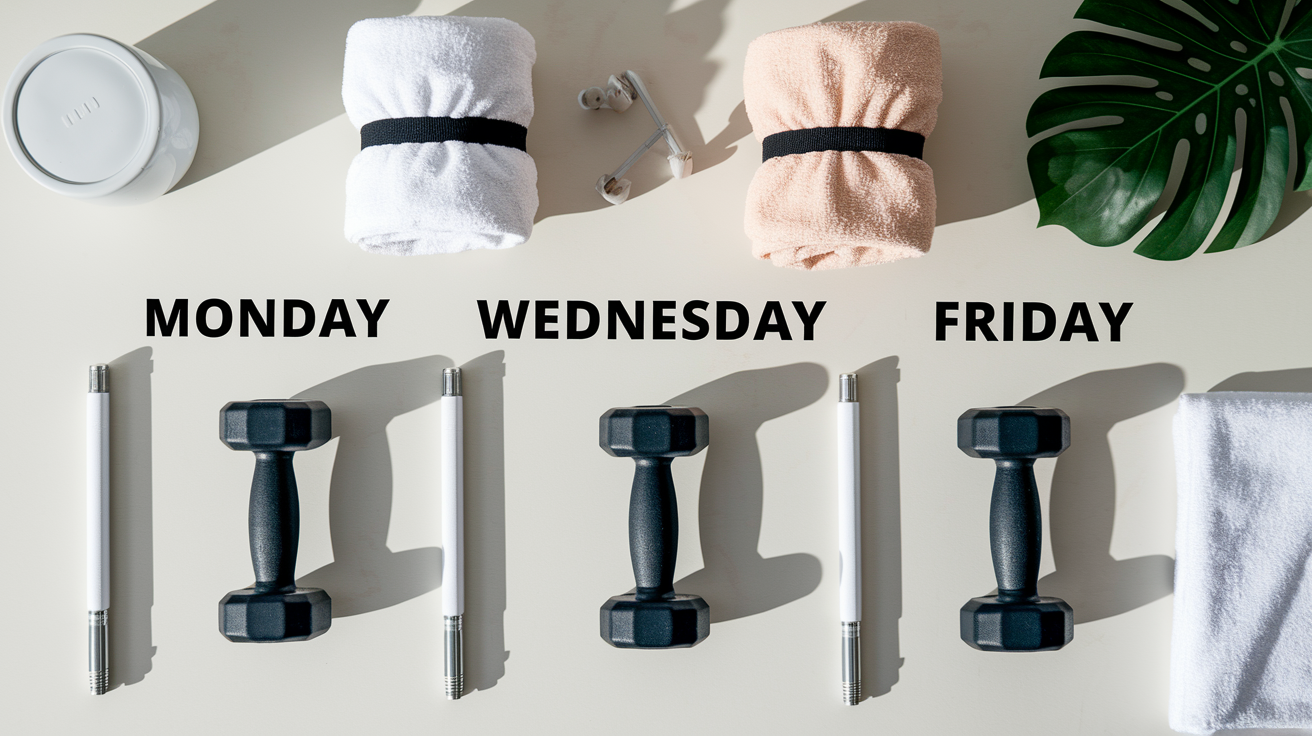
Spacing matters as much as the work itself. Training on non‑consecutive days (Monday, Wednesday, Friday is the classic layout) gives your muscles and nervous system roughly 48 hours to recover between sessions. That window is when muscle protein synthesis peaks, repairs happen, and strength adaptations lock in.
You can rotate through two alternating workouts (A and B, cycling A/B/A one week and B/A/B the next) or use three distinct sessions (A/B/C, then rotate to B/C/A in week two and C/A/B in week three). Both approaches work. The key is consistent exposure to each major movement pattern and muscle group three times per week without piling sessions back‑to‑back.
Sample weekly layouts:
- Option A: Monday (Workout A), Wednesday (Workout B), Friday (Workout C)
- Option B: Tuesday (Workout A), Thursday (Workout B), Saturday (Workout C)
- Option C (2-workout rotation): Week 1 Mon/Wed/Fri = A/B/A; Week 2 Mon/Wed/Fri = B/A/B
Sets, Reps, Rest, and Intensity Guidelines for Beginner Full‑Body Strength Training

Volume and intensity need structure, not guesswork. For compound lifts placed early in your session (squats, deadlifts, rows, presses), aim for 3 sets of 8 to 12 reps. If you’re chasing pure strength and using heavier loads, 5 to 8 reps works too. But most beginners benefit from the higher rep range because it builds technique and reduces injury risk. Accessories and isolation movements later in the session should land in the 10 to 15+ rep range, where form is simpler and metabolic fatigue matters more than peak force.
Rest intervals match the difficulty of the lift. Heavy, low‑rep compound sets demand 2 to 5 minutes of recovery so your central nervous system and local muscle fatigue reset. Upper‑body compounds and moderate‑rep work can get by with 1 to 2 minutes. Isolation and core exercises only need 60 to 90 seconds because they’re less systemically taxing.
Intensity should sit around RPE 6 to 8 for most working sets. Meaning you could do 2 to 4 more reps if pushed, but you stop shy of that. Occasionally taking a final set to RPE 9 (1 rep left in the tank) is fine. But grinding to failure every set as a beginner just teaches you to lift with bad form under fatigue.
| Lift Type | Sets | Reps | Rest |
|---|---|---|---|
| Primary compound (squat, deadlift, heavy press) | 3–5 | 5–12 | 2–5 minutes |
| Secondary compound (rows, RDLs, moderate press) | 3 | 8–12 | 1–2 minutes |
| Accessory/isolation (curls, leg curls, lateral raises) | 2–3 | 10–15+ | 60–90 seconds |
| Core/stability (planks, cable crunches) | 2–3 | 8–15 or time-based | 60–90 seconds |
Progression Methods for a Beginner 3‑Day Full‑Body Strength Program

Progress means making something harder over time in a trackable, repeatable way. The simplest method for beginners is double progression: start with a weight you can lift for the bottom of your rep range (say, 8 reps in an 8 to 12 range), then add one or two reps each session until you hit the top end on all your working sets. Once you can do 3 sets of 12 reps with clean form, increase the load by 5 to 10% and drop back to 8 reps. Repeat.
Linear progression works the same way but focuses on load. Add 2.5 to 5 pounds to upper‑body lifts and 5 to 10 pounds to lower‑body lifts each week (or every other week) as long as your technique stays solid and you’re hitting your target reps. If you miss reps two sessions in a row, repeat the same weight or drop by 5 to 10% and rebuild.
Deloads are part of the plan, not a sign of failure. Every 4 to 8 weeks, take one week where you reduce training intensity by 40 to 50%. Lighter weights, fewer hard sets, or stopping well short of fatigue. This lets your joints, tendons, and nervous system catch up without losing the skill or muscle you’ve built.
Progression options to cycle through:
- Add 1 to 2 reps per session until you reach the top of your range, then increase weight
- Increase load by 2.5 to 5 lb (upper body) or 5 to 10 lb (lower body) when you hit all prescribed reps
- Add one set to a lift (from 2 to 3 sets) after 4 to 6 weeks of consistent form
- Reduce rest periods slightly (like 90 seconds down to 75 seconds) for the same reps and weight
- Schedule a deload week every 4 to 8 weeks to manage accumulated fatigue
Sample 3‑Day Full‑Body Beginner Routine (Implement Today)

Here’s a plug‑and‑play template you can start this week. Each workout takes 45 to 75 minutes, hits every major muscle group, and follows the ordering and rest rules we’ve covered.
Day A: Squat and Press Focus
This session starts with a lower‑body compound, pairs a hip hinge with an upper‑body press, and finishes with pulling and core work.
- Barbell back squat or leg press: 3 sets × 8 to 12 reps, rest 2 to 3 minutes
- Dumbbell Romanian deadlift: 3 sets × 8 to 12 reps, rest 2 to 3 minutes
- Flat barbell or dumbbell chest press: 3 sets × 8 to 12 reps, rest 1 to 2 minutes
- Bent‑over barbell or dumbbell row: 3 sets × 8 to 12 reps, rest 1 to 2 minutes
- Cable abdominal crunch or plank: 3 sets × 8 to 12 reps or 30 to 60 seconds, rest 60 to 90 seconds
Day B: Deadlift and Row Focus
Lead with a hip hinge, follow with horizontal pulling, then add pressing and leg isolation.
- Trap bar or conventional deadlift: 3 sets × 5 to 8 reps, rest 3 to 5 minutes
- Chest‑supported dumbbell row or seated cable row: 3 sets × 8 to 12 reps, rest 1 to 2 minutes
- Incline dumbbell press or machine shoulder press: 3 sets × 10 to 15 reps, rest 1 to 2 minutes
- Leg extension or Bulgarian split squat: 3 sets × 10 to 15 reps (per leg if unilateral), rest 1 to 2 minutes
- Cable biceps curl: 2 sets × 10 to 15 reps, rest 60 to 90 seconds
Day C: Unilateral and Vertical Movement Focus
This day uses a squat variant, adds vertical pulling or pressing, and finishes with hamstrings and shoulders.
- Goblet squat or hack squat: 3 sets × 8 to 12 reps, rest 2 to 3 minutes
- Lat pulldown or assisted pull‑up: 3 sets × 8 to 12 reps, rest 1 to 2 minutes
- Flat machine chest press or push‑up variation: 3 sets × 10 to 15 reps, rest 1 to 2 minutes
- Lying leg curl or single‑leg Romanian deadlift: 3 sets × 10 to 15 reps, rest 1 to 2 minutes
- Cable lateral raise or dumbbell overhead press: 2 sets × 12 to 15 reps, rest 60 to 90 seconds
Exercise Substitutions and Home‑Gym Alternatives for a 3‑Day Full‑Body Program

Not everyone has a barbell, a bench, and a cable stack. That’s fine. The principles (compound‑first, progressive overload, structured volume and rest) apply no matter what equipment you’re working with. Goblet squats with a dumbbell or kettlebell hit the same movement pattern as a back squat. Dumbbell Romanian deadlifts train the hip hinge. Push‑ups and inverted rows replace presses and cable rows when you’re training at home or in a minimal setup.
The selection criteria stay the same: pain‑free, good form, target muscle engagement, and a clear path to make it harder. If you can add reps, slow down the tempo, or progress to a harder variation (like elevating your feet for push‑ups or adding a pause at the bottom of a goblet squat), the exercise qualifies.
Common substitutions for limited equipment:
- Barbell back squat → Goblet squat or dumbbell front squat
- Deadlift → Dumbbell Romanian deadlift or single‑leg RDL
- Barbell row → Inverted row (using a sturdy table or TRX), dumbbell row, or resistance band row
- Bench press → Push‑ups (standard, decline, or weighted with a backpack)
- Lat pulldown → Band‑assisted pull‑up, resistance band pulldown, or Australian pull‑up (inverted row)
Preventing Plateaus and Maintaining Long‑Term Progress in a 3‑Day Full‑Body Plan

Stagnation happens when stimulus stays flat. Rotating through A/B/C workouts week to week already introduces some variation. But you can also cycle rep ranges (one block focused on 5 to 8 reps, the next on 10 to 15), swap exercise variations every 4 to 6 weeks (front squat instead of back squat, incline press instead of flat), or add one set to your main lifts after a month of consistent performance.
Deloading every 4 to 8 weeks is non‑negotiable. Even if you feel fine, accumulated fatigue builds in tendons, joints, and your central nervous system. A deload week (where you drop weight by 40 to 50%, cut one set from each exercise, or simply take an extra rest day) lets those systems recover without losing the motor patterns and muscle you’ve built. It’s active recovery, not a week off.
Avoid the trap of adding sets too quickly. Beginners often grow just fine on 2 to 3 sets per exercise if technique and effort are dialed in. Only after 6 to 12 months of training should you consider pushing volume to 4+ sets per movement.
| Week | Sets/Exercise | Notes |
|---|---|---|
| 1–4 | 2–3 | Focus on technique, establish baseline loads |
| 5–8 | 3 | Add weight or reps weekly; hold volume steady |
| 9 | 2 (deload) | Reduce intensity 40–50%, maintain movement practice |
| 10–12 | 3–4 | Resume progression; consider adding one set to primary lifts |
When to Seek Extra Guidance or Modify the 3‑Day Full‑Body Strength Program

Not every roadblock is fixable with better programming. Persistent joint pain that doesn’t improve with rest, repeated form breakdown even with lighter loads, or an inability to progress for several weeks in a row are all signs you need outside input. A coach, physical therapist, or experienced trainer can spot technique issues, mobility restrictions, or programming errors that aren’t obvious from inside your own training.
Older beginners, people returning from injury, or anyone with cardiovascular or musculoskeletal concerns should get medical clearance before starting. Even with a green light, you might need to start with bodyweight variations, reduce volume to 1 to 2 sets, or prioritize machine‑based movements that offer more stability and less technical demand.
Signs to seek help:
- Joint pain (knees, shoulders, lower back) that persists beyond normal muscle soreness
- Inability to add weight or reps for 3 to 4 consecutive weeks despite good effort and recovery
- Repeated form breakdown on primary lifts, even after deloading and focusing on technique
Final Words
Pick a Monday/Wednesday/Friday layout and prioritize compound lifts first. Start with 2 sets per exercise, aim for 8–12 reps, and add reps then small weight increases.
Use clear order, with compounds before accessories, rest long enough for heavy sets, swap in goblet squats or band rows when needed, and plan deloads every 4–8 weeks. Track progress and fix technique before adding volume.
This guide showed how to design a 3-day full-body strength program for beginners. Follow the plan, be patient, and you’ll make steady gains.
FAQ
Q: What is the simplest 3-day full-body split for beginners?
A: The simplest 3-day full-body split for beginners is Monday/Wednesday/Friday (or similar non-consecutive days), prioritize compound lifts first, follow a short structured plan, and add small weekly overloads.
Q: How should I structure sets, reps, and rest for a beginner full-body program?
A: You should structure sets/reps with compounds at about 3 sets of 8–12 (or 5–8 for heavier lifts), accessories 10–15 reps, resting 2–5 minutes for compounds and 60–90 seconds for accessories.
Q: How do I choose exercises for a beginner 3-day full-body routine?
A: Choose exercises that are pain-free, allow good form, target the intended muscle, and can be progressively loaded; pick compounds first and pair agonist/antagonist movements like row then press.
Q: How should a beginner progress weight and sets week to week?
A: Beginners should use double progression: add reps to the top of the range, then increase weight 5–10%. Microload upper body by 2.5–5 lb and lower body by 5–10 lb; move 2 sets to 3–4 over months.
Q: What common mistakes make 3-day beginner programs fail?
A: Common mistakes include doing isolation before compounds, starting with too much volume, under-resting heavy sets, choosing non-progressive exercises, and poor exercise order that breaks form.
Q: How do I schedule a 3-day routine across the week?
A: You should schedule three non-consecutive days like M/W/F to allow ~48 hours recovery; rotate A/B/C or cycle B/C/A on week two to vary stimulus and keep progress steady.
Q: What are good home-gym substitutions for key lifts?
A: Good substitutions include goblet squats for barbell squats, dumbbell RDLs for Romanian deadlifts, band or ring rows for barbell rows, push-up variants for presses, and inverted rows for pulling work.
Q: How do I prevent plateaus and keep long-term progress?
A: Prevent plateaus by rotating week templates, deloading every 4–8 weeks at 40–50% intensity, avoiding endless set creep, and regularly refining technique instead of just adding volume.
Q: When should I get professional help or modify the beginner program?
A: You should seek a coach or modify the plan for persistent joint pain, repeated form breakdown, inability to progress after consistent effort, major mobility limits, or medical concerns.
Q: What’s the simplest next step I can do this week to start a 3-day full-body plan?
A: The simplest next step is pick M/W/F, choose 4–6 moves (compounds first), do 2 sets of 8–12, track loads, and plan to add small weight or extra reps each week.

