Featured
Strength Training Program: Build Muscle with Proven Workout Plans
By fitness
September 12, 2026
Field Notes
Walking into the gym without a plan is the fastest way to waste months.
You lift random things, copy someone, and wonder why you’re not stronger.
This post fixes that. I’ll show a clear strength training program with the right frequency, exercises, sets and reps, and simple progression rules.
You’ll find beginner-friendly full-body and split options, warm-up and recovery tips, and a ready-to-run 3- or 4-day plan.
Read on to stop guessing and start adding real weight to the bar.
Solving the Need for a Clear Strength Training Program Structure

Most people walk into the gym with no real plan. They gravitate toward whatever machine’s closest or mimic the person next to them. Two weeks pass and they’re wondering why they don’t feel any stronger.
A structured strength training program fixes that. You get a roadmap: exercises, sets, reps, rest periods, progression rules. Every session has a purpose. You stop guessing and start tracking. That alone does wonders for motivation. Look back at a log and see you deadlifted 135 pounds in Week 1 and 165 pounds in Week 8. Progress becomes real.
A complete strength training program includes five pieces:
- Frequency: How many days per week you train (2 to 6 sessions, depending on experience and schedule).
- Exercises: Which movements you’ll perform, prioritizing compound lifts like squats, deadlifts, presses, and rows.
- Sets and reps: Volume targets for each exercise (commonly 3 to 4 sets of 8 to 12 reps for muscle building, 3 to 5 sets of 3 to 5 reps for strength).
- Progression: Rules for adding weight or reps over time. Progressive overload keeps the muscle building signal active.
- Warm up and recovery: Dynamic warm ups before training, cooldown stretches after, and scheduled rest days to allow repair.
Here’s a simple beginner-friendly full body program you can run three times per week (Monday/Wednesday/Friday), resting at least one day between sessions. Perform 3 sets of each exercise. Start with a weight that lets you complete the high end of the rep range with moderate difficulty.
- Goblet squat: 8 to 10 reps
- Dumbbell Romanian deadlift: 8 to 10 reps
- Push up (elevated if needed): 8 to 10 reps
- Dumbbell single arm row: 8 to 10 reps per side
- Dumbbell overhead press: 8 to 10 reps
- Plank hold: 20 to 30 seconds
That’s the structure. Train those movements, add a small amount of weight when you hit the top of the rep range for all sets, and you’ll see measurable strength gains within four weeks.
Why Strength Training Programs Fail Without the Right Foundations

Programs collapse for a few predictable reasons. People pick routines designed for advanced lifters when they’re still learning how to squat. They train five days one week, zero the next. They never add weight because they don’t know when or how much. Or they skip warm ups, ignore volume targets, and wonder why their shoulders hurt.
Structure alone won’t save you if the foundation’s missing. You need alignment between your program and your experience, time, equipment, and goals. You also need to follow core training principles that govern how muscle and strength develop. Principles that apply to every routine, regardless of how you split the week.
| Error | Result |
|---|---|
| Skipping progressive overload | Stalled progress; muscle adapts once, then stops growing |
| Inconsistent training frequency | Insufficient stimulus; skill and coordination don’t improve |
| Ignoring weekly volume targets | Either undertraining (no gains) or overtraining (burnout, injury) |
| Poor exercise selection | Missed movement patterns; imbalances; inefficient use of time |
Progressive overload is the single most important concept. It means doing slightly more than last time. Adding weight, reps, or sets. Muscle grows in response to new stress. If you bench press 95 pounds for 3 sets of 8 every week for six months, your body has no reason to adapt. Add five pounds when you can complete all reps cleanly, and growth continues.
Every program should cover the basic movement patterns: squat (knee dominant lower body), hinge (hip dominant lower body), horizontal push (bench press), vertical push (overhead press), horizontal pull (row), and vertical pull (pull up or lat pulldown). Together, these movements develop balanced strength and prevent asymmetries.
Rep range guidelines determine training outcomes. Lifting 1 to 5 reps at high intensity builds maximum strength. Six to twelve reps at moderate intensity drives muscle growth (hypertrophy). Twelve plus reps at lighter loads improve muscular endurance. Beginners benefit most from the 6 to 12 range because it builds both size and strength while allowing enough reps to practice form.
Warm up protocols matter for injury prevention and performance. Start with five to ten minutes of light cardio or dynamic stretches. Leg swings, arm circles, bodyweight squats. Raise core temperature and lubricate joints. Never walk into the gym cold and load a barbell.
Weekly volume targets vary by goal and experience. For hypertrophy, aim for roughly 10 to 20 sets per muscle group per week. Strength focused programs use fewer total reps but heavier loads. Beginners start on the lower end; advanced lifters push the upper limit. Training a muscle group twice per week tends to produce better results than once per week splits because the muscle building signal needs regular renewal.
Building an Effective Full Body Strength Training Program (Most Common Solution)
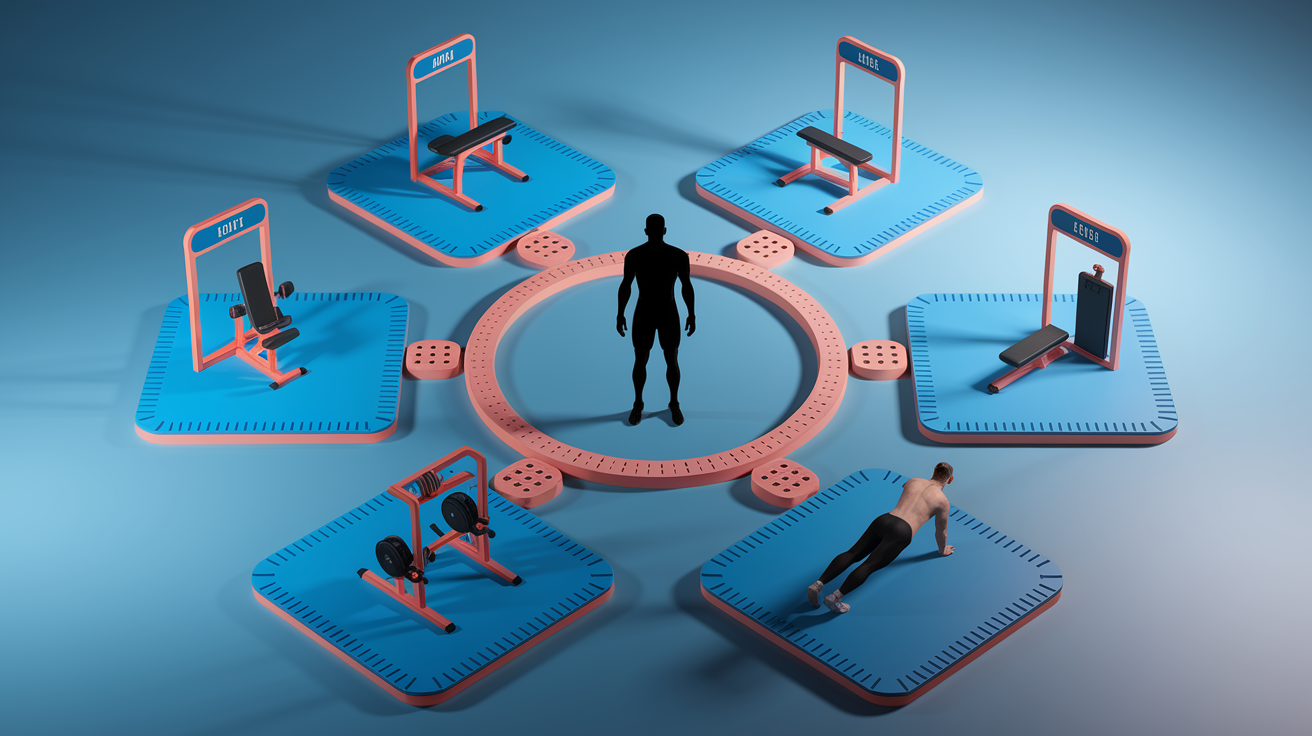
Full body routines are the default starting point for most people. You train every major muscle group in each session, usually two to three times per week with at least one rest day between workouts. This structure works because beginners don’t need high volume to make progress. They need frequency and practice with the fundamental movement patterns.
Sessions last 45 to 60 minutes and include four to six compound exercises. You warm up, perform your programmed lifts, then cool down. Because you’re hitting everything each time, scheduling is flexible. Miss a Wednesday? Train Thursday. Life gets busy on Friday? You’ve already worked your legs twice that week, so the impact is minimal. That flexibility keeps people consistent. And consistency drives results.
Sample 3 Day Full Body Program
Perform this routine Monday, Wednesday, Friday. Complete 3 to 4 sets of 8 to 10 reps for each exercise. Rest 90 to 120 seconds between sets.
- Barbell back squat
- Barbell bench press
- Barbell bent over row
- Barbell Romanian deadlift
- Dumbbell overhead press
- Plank hold: 30 to 45 seconds
Add weight when you can complete all sets at the top of the rep range with good form. For upper body lifts, increase by 2.5 to 5 pounds. For lower body lifts, add 5 to 10 pounds.
Recommended accessory movements to rotate in or add at the end of sessions:
- Dumbbell lunges: addresses single leg strength and balance.
- Face pulls: strengthens rear delts and upper back health.
- Dumbbell biceps curl: direct arm work for aesthetics.
- Tricep pushdown: complements pressing volume.
- Hanging knee raise: core stability and hip flexor control.
Creating a 3 Day Strength Training Program Using Push/Pull/Legs

Push/Pull/Legs (PPL) splits organize training by movement category instead of full body coverage. Push days train chest, shoulders, and triceps. Pull days train back and biceps. Leg days cover quads, glutes, hamstrings, and calves. This structure works well for intermediate lifters who can handle higher weekly volume and want more exercise variety per muscle group.
You can run PPL three days per week (one cycle) or six days per week (two cycles). The three day version suits people with limited time or lower recovery capacity. The six day option maximizes volume and frequency for experienced lifters chasing size or strength. Either way, the split lets you focus fully on one category per session, which means more exercises per muscle and higher per session intensity without excessive fatigue.
Push Day
Target: chest, shoulders, triceps. Complete 3 to 4 sets of 8 to 12 reps for each movement.
- Barbell bench press
- Dumbbell incline press
- Dumbbell shoulder press
- Dumbbell lateral raise
- Tricep rope pushdown
Pull Day
Target: back, biceps. Complete 3 to 4 sets of 8 to 12 reps.
- Barbell deadlift (3 to 5 reps if prioritizing strength)
- Barbell bent over row
- Lat pulldown
- Face pull
- Dumbbell biceps curl
Legs Day
Target: quads, glutes, hamstrings, calves. Complete 3 to 4 sets of 8 to 12 reps.
- Barbell back squat
- Bulgarian split squat
- Leg press
- Lying hamstring curl
- Standing calf raise
Rotate your weekly schedule like this: Week 1 might be Push/Pull/Legs/Rest/Push/Pull/Legs. Week 2 starts with Rest, then Push/Pull/Legs/Rest/Push/Pull. This rotation ensures you hit each category twice per week while preserving rest days.
Designing a 4 Day Upper Lower Strength Training Program

An upper lower split divides the body into two training blocks. Upper body (chest, back, shoulders, arms) and lower body (quads, glutes, hamstrings, calves). You train each block twice per week. This setup works well for intermediate lifters who want more volume per muscle group than a full body routine offers but don’t need the specialization of a PPL split.
You train four days per week, typically Monday (Upper A), Tuesday (Lower A), Thursday (Upper B), Friday (Lower B). Each muscle group gets hit twice, but with different exercises or rep schemes each session to avoid monotony and distribute fatigue.
Upper Day
Upper A emphasizes horizontal pressing and pulling. Upper B prioritizes vertical pressing and pulling. Both sessions include arm isolation work.
Upper A sample:
- Barbell bench press: 4 sets of 6 to 8 reps
- Barbell bent over row: 4 sets of 6 to 8 reps
- Dumbbell incline press: 3 sets of 10 to 12 reps
- Cable face pull: 3 sets of 12 to 15 reps
- Barbell biceps curl: 3 sets of 10 to 12 reps
Upper B sample:
- Barbell overhead press: 4 sets of 6 to 8 reps
- Pull up or lat pulldown: 4 sets of 6 to 8 reps
- Dumbbell shoulder press: 3 sets of 10 to 12 reps
- Chest supported dumbbell row: 3 sets of 10 to 12 reps
- Overhead tricep extension: 3 sets of 10 to 12 reps
Lower Day
Lower A and Lower B both include a squat or hinge variation, a unilateral movement, and posterior chain or calf work.
Lower A sample:
- Barbell back squat: 4 sets of 6 to 8 reps
- Romanian deadlift: 3 sets of 8 to 10 reps
- Leg press: 3 sets of 10 to 12 reps
- Lying hamstring curl: 3 sets of 10 to 12 reps
Lower B sample:
- Barbell deadlift: 4 sets of 5 reps
- Bulgarian split squat: 3 sets of 8 to 10 reps per leg
- Leg extension: 3 sets of 12 to 15 reps
- Standing calf raise: 4 sets of 12 to 15 reps
Weekly planning options for the 4 day upper lower split:
- Monday/Tuesday/Thursday/Friday: classic back to back, rest midweek and weekend.
- Monday/Wednesday/Friday/Saturday: spreads sessions more evenly across the week.
- Tuesday/Wednesday/Friday/Saturday: suits people who prefer weekday rest at the start of the week.
- Flexible rotation: if you miss a day, pick up where you left off rather than skipping a session entirely.
Structuring Advanced Strength Training Programs (Periodized Options)

At some point, linear progression stops working. You can’t add five pounds to the bar every week forever. Your body adapts, recovery becomes harder, and progress plateaus. That’s when advanced lifters turn to periodization. Structured cycles that manipulate training variables (volume, intensity, exercise selection) to prevent adaptation and push past limits.
Periodization isn’t magic. It’s planned variation. Instead of doing the same weight and reps every week, you rotate between phases that emphasize different qualities: hypertrophy (muscle size), strength (maximum force production), and power (speed and explosiveness). Each phase builds on the last.
Undulating Periodization
Undulating periodization changes volume and intensity within the same week or even the same session. For example, Monday might be 4 sets of 5 reps at 85% of your one rep max (strength focus), Wednesday might be 3 sets of 10 reps at 70% (hypertrophy), and Friday might be 5 sets of 3 reps at 90% (peak strength). This approach prevents accommodation because the stimulus keeps shifting. It works well for intermediate lifters who respond quickly to variety and need frequent exposure to different rep ranges to continue progressing.
Linear Periodization
Linear periodization uses multi week blocks that progress from high volume and lower intensity (hypertrophy phase) to low volume and high intensity (strength or peaking phase). A typical 12 week cycle might include four weeks at 3 to 4 sets of 10 to 12 reps, four weeks at 4 sets of 6 to 8 reps, then four weeks at 5 sets of 3 to 5 reps. This model is predictable and easy to program but requires discipline. You can’t rush ahead or skip phases.
Block Periodization
Block periodization organizes training into focused mesocycles, each targeting a single quality. A hypertrophy block might last four weeks with high volume and moderate intensity. Then you switch to a strength block. Lower reps, heavier loads, reduced volume. Finally, a power or peaking block emphasizes speed, explosiveness, or testing your one rep max. Blocks don’t overlap; each phase is distinct. This structure suits advanced lifters preparing for competition or specific performance goals.
Conjugate Method
The conjugate method, popularized by Westside Barbell, trains max effort (heavy singles, doubles, or triples) and dynamic effort (speed work with submaximal loads) in the same week, alongside high volume accessory work. Max effort days rotate main lifts every one to three weeks to avoid accommodation. Dynamic effort days develop explosive strength and bar speed. It’s complex, demanding, and best suited to experienced strength athletes or powerlifters.
| Periodization Type | Main Benefit | Recommended User Level |
|---|---|---|
| Undulating | Prevents stagnation with frequent variation | Intermediate to advanced |
| Linear | Simple, predictable progression over weeks | Intermediate |
| Block | Focused development of one quality at a time | Advanced |
| Conjugate | Simultaneous strength and speed development | Advanced, competitive lifters |
Customizing Strength Training Programs for Specific Populations

Not every lifter fits the standard template. Age, sex, training history, and life circumstances all influence how you should structure volume, intensity, exercise selection, and recovery. Tailoring a program to these factors improves adherence, reduces injury risk, and accelerates results.
Women
Women respond to strength training the same way men do. Progressive overload drives adaptation. The main differences are hormonal and structural, not muscular. Women typically have less upper body muscle mass and may need slightly more volume or frequency to stimulate growth in the chest, shoulders, and arms. Lower body strength often matches or exceeds men’s relative to bodyweight, so don’t assume lighter loads are necessary for squats or deadlifts. Many female lifters benefit from higher training frequency (four to six days per week) and can recover quickly from lower body sessions. Menstrual cycle phases can influence energy and recovery; some women adjust volume or intensity during certain weeks based on how they feel.
Seniors
Older adults (50 plus) build muscle and strength effectively but require joint friendly exercise selection and longer recovery windows. Swap high impact or high shear movements (heavy back squats, overhead barbell presses) for dumbbell or machine alternatives that reduce spinal load and allow better range control. Increase rep ranges to 10 to 15 per set to build strength and size without maximal joint stress. Prioritize unilateral work (single leg exercises, single arm presses) to address balance and coordination, which decline with age. Train two to four days per week with at least one full rest day between sessions. Emphasize mobility work and longer warm ups to maintain joint health.
Youth
Resistance training is safe and beneficial for kids and adolescents when properly supervised and programmed. Focus on bodyweight mastery first. Push ups, pull ups, squats, lunges, planks. Before adding external loads. When introducing weights, use light dumbbells or kettlebells and emphasize perfect form over heavy loads. Avoid maximal lifts (1 to 3 rep sets) until skeletal maturity; stick to 8 to 15 reps per set. Sessions should be short (30 to 45 minutes), fun, and varied to keep engagement high. Strength gains in youth come primarily from neuromuscular adaptations (learning to recruit muscle efficiently) rather than hypertrophy, so don’t expect dramatic size changes.
Postpartum
Returning to strength training after pregnancy requires gradual reintroduction of load and volume. Start with bodyweight movements and core stabilization exercises (dead bugs, bird dogs, planks) to rebuild pelvic floor and deep abdominal strength. Avoid heavy overhead pressing or loaded spinal flexion until cleared by a healthcare provider. Progress slowly. Add resistance only when movement feels controlled and pain free. Hormonal changes (especially if breastfeeding) can affect recovery and energy, so listen to your body and adjust volume as needed. Two to three full body sessions per week is a reasonable starting point.
Universal safety rules for all populations:
- Prioritize form and control over load. Perfect reps prevent injury.
- Progress gradually. Add weight or reps only when current levels feel manageable.
- Include rest days and mobility work to support recovery and joint health.
Recovery, Nutrition, and Supportive Habits for Long Term Strength Progress

Training breaks muscle down. Recovery builds it back up. Nutrition fuels both. If you neglect either, progress stalls no matter how good your program is.
Sleep is the single most powerful recovery tool. Aim for seven to nine hours per night. During deep sleep, your body releases growth hormone, repairs damaged tissue, and consolidates motor learning from your training sessions. Chronic sleep deprivation blunts protein synthesis, increases cortisol, and reduces performance. If you’re stuck on a plateau, look at your sleep quality before tweaking your program.
Active recovery (light movement on rest days) supports circulation, reduces soreness, and maintains mobility without adding fatigue. A 20 minute walk, easy bike ride, or yoga session keeps blood flowing to muscles and speeds waste product clearance. Avoid intense cardio or additional lifting on scheduled rest days; the goal is movement, not more stress.
Protein intake is the nutritional cornerstone of strength training. Aim for at least 1.4 grams per kilogram of bodyweight daily, spread across three to five meals. Protein provides the amino acids your muscles need to repair microtears and build new tissue. If you weigh 70 kilograms, that’s roughly 98 grams of protein per day. Achievable through chicken, fish, eggs, Greek yogurt, tofu, lentils, and protein shakes. Vegetarians and vegans can hit these targets with planning; combine legumes, soy, seitan, and supplemental protein powder if needed.
Carbohydrates fuel your training sessions. Eat a carb rich meal or snack one to three hours before lifting. Oatmeal, rice, fruit, bread. Top off glycogen stores and support performance. Post workout carbs help replenish what you burned and support recovery, though protein remains the priority.
Calorie balance determines whether you gain, lose, or maintain weight. To build muscle, eat a slight surplus (roughly 5 to 10% above your maintenance calories). To lose fat while preserving muscle (body recomposition), eat at maintenance or a small deficit (10 to 15% below maintenance) and keep protein high. Recomposition is slower than pure bulking or cutting but allows simultaneous fat loss and muscle gain, especially for beginners or those returning after a break.
Stress management influences recovery. Chronic stress elevates cortisol, which impairs muscle repair, disrupts sleep, and reduces training motivation. Simple daily habits help: ten minutes of deep breathing, a short walk outside, journaling, or time with friends. Treat stress reduction as part of your program, not a luxury.
Active recovery strategies to rotate into your week:
- Walk 20 to 30 minutes on off days to support circulation without taxing the nervous system.
- Foam roll or use a massage ball on sore areas to reduce muscle tension and improve range of motion.
- Gentle stretching or yoga for 15 to 20 minutes to maintain mobility and mental calm.
- Low intensity cycling or swimming if you enjoy cardio but want to avoid impact or heavy eccentric load.
Preventing Setbacks in Your Strength Training Program

Injuries, burnout, and plateaus derail more programs than anything else. Most setbacks are preventable with smart load management, technical discipline, and planned recovery.
Proper form protects joints and ensures the target muscles do the work. If your knees cave inward during squats, your lower back rounds on deadlifts, or your shoulders shrug during rows, you’re leaking force and inviting injury. Film your lifts from multiple angles and compare them to tutorial videos or have a coach review your technique. Small corrections (externally rotating your hips, bracing your core harder, retracting your shoulder blades) can eliminate pain and unlock progress.
Load management means progressing at a sustainable pace. Adding weight too quickly overloads tendons, ligaments, and connective tissue, which adapt more slowly than muscle. Stick to the NSCA guidelines: increase upper body lifts by 2 to 5 pounds and lower body lifts by 5 to 10 pounds per cycle. If a jump feels too aggressive, use fractional plates (0.5 to 1 pound increments) to micro load. Slow and steady wins.
Mobility and flexibility drills to include weekly:
- Hip 90/90 stretch: improves internal and external hip rotation for safer squats and deadlifts.
- Thoracic spine rotations: maintains upper back mobility for overhead pressing and rowing.
- Ankle dorsiflexion stretch: allows deeper squat depth and reduces knee stress.
- Shoulder pass throughs with a band or PVC pipe: keeps shoulder capsule healthy for pressing and pulling.
Deload weeks are scheduled recovery periods where you reduce volume or intensity by 40 to 50% for one week. Run a deload every four to six weeks, or whenever you feel persistently fatigued, sore, or unmotivated. A deload isn’t a week off. You still train, just lighter. This planned break allows your nervous system and connective tissues to catch up with your muscle adaptations, and you’ll often return stronger.
Plateaus happen when your body fully adapts to the current stimulus. If your lifts haven’t budged in four weeks despite good sleep, nutrition, and effort, change one variable: swap an exercise (front squat instead of back squat), adjust your rep range (5×5 instead of 3×10), add a training day, or increase volume slightly. Small tweaks restart progress without overhauling your entire program.
When to Seek Coaching or Structured Guidance for Your Program

Most people can follow a well designed template and make solid progress for months or even years. But there are moments when outside help accelerates results, prevents injury, or breaks through a stubborn plateau.
If your form consistently breaks down under load (your squat depth drops, your deadlift back rounds, your bench press flares your elbows dangerously) you need real time feedback. A coach can spot mechanical errors you can’t see or feel and offer cues that fix them immediately. Video form checks help, but they’re slower and less precise than in person coaching. One session with a skilled trainer can correct years of inefficient movement patterns.
When progress stalls for more than four to six weeks despite good adherence, nutrition, and recovery, it’s time for a more sophisticated template or periodization model. Generic programs work well early on, but advanced lifters need individualized volume, intensity, and exercise selection based on their strengths, weaknesses, and goals. A coach or detailed program (like those from certified strength organizations) provides that customization.
Signs you need coaching or a more advanced template:
- Chronic pain during or after training that doesn’t resolve with rest or form adjustments.
- Zero progress for six plus weeks despite consistent effort and tracking.
- Frequent injuries or recurring setbacks that derail your training cycle.
Final Words
Jump into a plan: we laid out why structure matters, showed full-body, push/pull/legs, and upper-lower options, and explained when periodized cycles help. You got a simple beginner template plus clear sets, reps, and progression rules to follow.
We also covered recovery, nutrition, injury prevention, and signs you might need coaching. There’s a short checklist for what a complete program includes.
Use this guide to build a simple, measurable strength training program and start this week — steady, consistent work wins.
FAQ
Q: What is the best exercise app for perimenopause?
A: The best exercise app for perimenopause is one that prioritizes strength training, short sessions, and hormone-aware guidance. Pick apps with progressive overload, tracking, and recovery tools—examples: FitOn, SWEAT, MyMenopauseHub.
Q: Can I lift weights with fibromyalgia?
A: You can lift weights with fibromyalgia, but start very light, use low-impact moves, pace sessions, prioritize form, stop if pain spikes, progress slowly, and coordinate plans with your healthcare team.
Q: What is the 3-3-3 rule for gym?
A: The 3-3-3 rule for the gym means doing three sets of three reps per exercise. It’s a low-rep, high-load strength template using compound lifts and longer rests (about 2–5 minutes).
Q: Can I lift weights while taking Zepbound?
A: You can lift weights while taking Zepbound, but monitor energy, hydration, and blood sugar, prioritize protein and resistance work to preserve muscle, lower intensity if nauseous, and check with your prescriber.